If you've ever walked through a mining operation, a wastewater treatment plant, or a chemical processing facility, you've likely seen one of our thickeners at work-those large, quiet tanks that quietly do the heavy lifting of separating solid waste from liquid streams. As a supplier of solid-liquid separation thickeners, I've spent countless hours in plants with operators who ask the same question: "Should we go with a circular or rectangular unit?" It's not a trivial choice-this decision shapes everything from separation efficiency to maintenance costs, floor space, and even how well the unit performs with their specific slurry. Over 12 years in this business, I've seen projects derailed by rushing this call, and others that thrived because they took the time to unpack the real differences between these two designs. Let's break it down without the jargon, using what I've learned from working side-by-side with plant teams around the globe.
First, let's ground this in what a thickener actually does, because that's the core of every design choice. A thickener works by slowing a slurry (a mix of solid particles and liquid) down enough that gravity pulls the solid particles to the bottom of the tank, forming a dense, pumpable sludge, while the clear liquid rises to the top and can be reused or discharged. The equipment that makes this happen is a scraper system that pushes that settled sludge to a central outlet for collection. Now, the geometry of the tank itself-circular or rectangular-isn't just a shape preference; it impacts how evenly the slurry spreads, how consistently solids settle, and how much the scraper has to work to move the sludge.
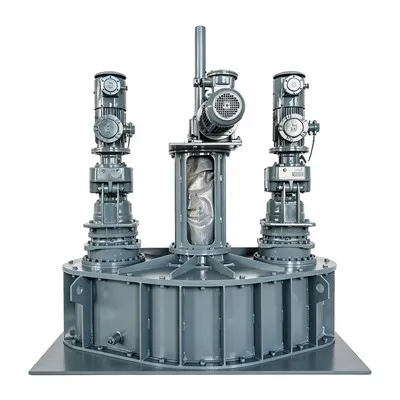
Let's start with circular thickeners, which are the workhorse of nearly every heavy industry that uses thickeners. The math here is simple: a circle has the largest area for a given perimeter, which means less wall material and a more uniform flow pattern across the tank's entire surface. When you pump slurry into a circular tank, inlet distributors are designed to spread the material evenly from the center or the edge, so the velocity of the slurry slows down uniformly everywhere. That consistency matters because if some parts of the tank have faster-moving slurry, fine solid particles get carried away in the overflow liquid instead of settling-wasting product or creating more downstream waste. Most circular thickeners also use a central drive scraper, a design that's been refined for over a century. The scraper arm rotates 360 degrees, pushing sludge toward the center outlet in a smooth, circular path. This design is why we've sold so many of our Center Drive High-Efficiency Thickener over the years; it's been tested in copper mines in Chile, coal processing plants in Australia, and municipal wastewater facilities in Germany. The steady, even motion of the central drive doesn't put uneven stress on the scraper, so maintenance is predictable rather than reactive.
But circular thickeners aren't one-size-fits-all. One key downside is their floor space efficiency, especially if you have a long, narrow plant footprint. A circular tank has unused corner space (or rather, the area near the tank walls doesn't contribute to effective settling as evenly as the center), so if your plant is laid out in a straight line, a circular unit might leave gaps you can't use for other equipment. Also, for very large capacities, circular thickeners can require extremely wide diameters-some topping 150 feet across-which means transporting the tank sections to the job site becomes a logistical nightmare. I remember a project in Alberta a few years back where a mine tried to order a 140-foot circular thickener, only to find that the shipping route couldn't accommodate the long tank panels. We ended up working with them to adjust the design, but that delay cost them two months of production.
Now, rectangular thickeners-sometimes called clarifier-thickeners, since many are used where clarification and thickening happen in the same tank-are less common for high-capacity mining, but they have a loyal following in industries with specific layout or process needs. The biggest advantage here is that rectangular tanks fit neatly into linear or multi-unit process lines. If you're building a wastewater treatment plant in a long, narrow urban site, or you need to string multiple thickeners in a straight line to match existing equipment modules, rectangular tanks eliminate that wasted corner space. The flow pattern in a rectangular thickener is different: slurry is pumped into one end and flows horizontally to an outlet at the other end, with the bottom sloped to allow scrapers to push settled sludge toward a hopper at one or both ends. Some operators prefer this because it's easier to integrate with other linear process steps-like if you have a series of mixing tanks feeding into a straight line of thickeners.
But rectangular thickeners have real trade-offs when it comes to separation quality. The horizontal flow means that near the inlet end, the slurry is still moving fast, and near the outlet end, the liquid has to travel the full length of the tank. This can create dead zones or areas where the liquid velocity varies a lot-meaning fine solids might get carried out in the overflow, reducing thickening efficiency. I've seen a food processing plant switch from a rectangular clarifier-thickener to a circular unit because their fruit pulp solids were getting lost in the overflow, cutting their product recovery by 12% a year. The scraper system for rectangular units is also different-most use a chain-and-flight scraper that runs along the bottom of the tank. This system is more prone to wear at the ends of the tank, where the scraper turns around, and it requires more frequent inspections than a central drive system for circular units. That's not to say rectangular thickeners can't work-they're great for lower-capacity, less demanding applications where layout is the top priority-but they often fall short in efficiency for high-throughput operations.
Let's talk about real-world use cases to make this concrete. A gold mine I worked with in Nevada was processing 10,000 tons of ore a day, and they needed a thickener that could handle high volumes without losing fine gold particles. They initially considered a rectangular unit because their plant layout was linear, but after testing a pilot circular thickener, they saw that their fine gold recovery jumped 8% because the uniform flow let all the solid particles settle. They went with our Center Drive High-Efficiency Thickener, and three years later, they still call it their most reliable piece of solid-liquid separation equipment. On the flip side, a small wastewater treatment plant in a downtown building in Tokyo had a tight, rectangular plot of land. They didn't need to process 10,000 tons a day-they just needed to treat 500 cubic meters of sewage daily, and their existing process was laid out in a straight line. A rectangular clarifier-thickener was the only option that fit, and it's been working well for them for seven years.
Another key difference is in floor space and modularity. For large, standalone units, circular thickeners often have a smaller footprint for the same capacity. A 100-foot diameter circular thickener can process around 500 tons of solids per hour, while a rectangular thickener with the same total area would need to be much longer-say 200 feet by 50 feet-taking up twice as much linear space. That's a big deal when every square foot of a plant costs money, especially in land-scarce areas. But if you need to expand your process line by adding multiple thickeners, rectangular units can be bolted together end-to-end, making expansion easier without reconfiguring the entire space. Circular units would need to be spaced apart, as each requires access around the full perimeter for maintenance.
Maintenance is another area where the two designs diverge. Circular thickeners with central drive scrapers have fewer moving parts that are exposed to sludge. The drive system is on top of the tank, so it's easy to access for lubrication and repairs, and the scraper arms don't come into contact with the tank walls, reducing wear. Our Industrial Sedimentation Tank Scraper line, which we pair with our circular thickeners, is designed to run 24/7 with only quarterly inspections. Rectangular thickeners, on the other hand, have chain-and-flight systems that are submerged in sludge, which can cause corrosion and wear over time. The chain also needs to be tensioned regularly, and the end sprockets where the scraper turns are prone to buildup of solid particles, leading to downtime. I've seen a chemical plant with three rectangular thickeners spend 20% more on maintenance than a neighboring plant with circular units of the same capacity.


Don't get me wrong-there are still good reasons to choose a rectangular thickener. If you're operating in a remote location with no equipment to transport large circular tank sections, a rectangular thickener made of smaller, bolted panels might be easier to assemble on site. Or if you're using a thickener as both a clarifier (to produce clear overflow) and a thickener (to produce dense underflow) in a small footprint, a rectangular unit can handle both functions effectively, though not as efficiently as a dedicated circular Clarifier Thickener or Settling Thickener.
The bottom line is that the choice between circular and rectangular thickeners comes down to three factors: your process capacity, your plant layout, and your priority between efficiency and maintenance ease. For high-throughput operations (100+ tons of solids per hour) where maximizing recovery and minimizing downtime is critical, circular thickeners are almost always the better bet. Their uniform flow, reliable central drive systems, and higher efficiency make them worth the slightly higher upfront cost. For smaller, low-capacity operations with linear or constrained layouts, rectangular thickeners can be a practical, space-saving solution.
As a supplier who's seen hundreds of projects, my advice is to test both if you can. Many of our clients run pilot tests with our thickeners before committing, which lets them see exactly how their specific slurry settles in each geometry. We don't push one design over the other-we work with plant teams to figure out what fits their needs. If you're not sure which thickener is right for your process, don't guess. Reach out, and we can help you run through the numbers, weigh the trade-offs, and find a solution that works for your operation. We've got a range of options, from high-efficiency circular units to clarifier-thickeners, that are built to handle all kinds of solid-liquid separation challenges. Let's work together to make sure your thickener doesn't just meet your needs, but exceeds them.
References
- Kawatra, S. K. (2019). Solid-Liquid Separation: Principles, Equipment, and Practices. Society for Mining, Metallurgy & Exploration.
- Tiller, F. M., & Kwon, S. (1994). Thickener Design and Operation. Mineral Processing and Extractive Metallurgy Review, 11(1), 1-28.
- Davis, C. L., & Sorem, R. K. (2001). Circular vs. Rectangular Thickener Performance in Industrial Applications. Proceedings of the International Mineral Processing Congress, 1, 457-465.
- American Water Works Association. (2020). Clarifier and Thickener Design and Operation Manual (5th ed.). AWWA.
- Local, S. (2021). Case Studies: Thickener Selection for Mining and Municipal Applications. Industrial Water Journal, 18(3), 22-27.