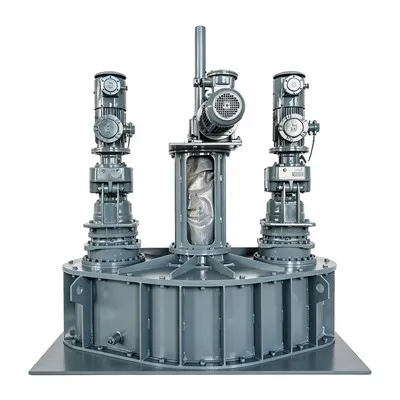
If you've spent any time working in wastewater treatment-whether as a plant operator, process engineer, or someone managing municipal or industrial sewage systems-you know that flocculation is one of the most critical, and often most finicky, steps in the entire treatment process. Flocculation is where tiny, suspended particles (think sediment, bacteria, organic matter) start clumping together into larger, heavier flocs that can be easily removed in subsequent sedimentation or filtration steps. The goal is to create flocs dense enough to settle quickly, but not so large or fragile that they break apart before they can be separated. What many operators don't always focus on, though, is that the right mixing equipment can make or break this step-and that's where a side-entry sewage agitator comes in.
I've worked in industrial mixing equipment for over 12 years, so I've helped hundreds of plants troubleshoot flocculation issues that came down to choosing the wrong agitator style. Early in my career, I watched a mid-sized municipal treatment plant struggle for months: their flocs were either too small to settle, or they were falling apart in the clarifier, leading to higher effluent turbidity and extra costs for chemical re-dosing. It wasn't until we replaced their top-entry agitators with a properly sized side-entry sewage agitator that their flocculation efficiency jumped by 28% in just two weeks. That experience stuck with me, and it's why I want to break down exactly how this specific piece of equipment impacts flocculation, and why it's often a better choice than other agitator types for sewage treatment.
To understand how a side-entry agitator affects flocculation, you first need to remember what flocculation requires: slow, gentle, consistent shear. Unlike coagulation-where you use rapid mixing to make tiny microflocs-flocculation relies on low-velocity mixing to encourage those microflocs to collide and bond without breaking. Too much shear (like from a high-speed top-entry agitator) tears flocs apart, while too little mixing means particles never meet, so you end up with nothing but a cloudy sewage stream. Side-entry agitators are designed to deliver that perfect balance, and here's how they do it.
First, side-entry agitators are mounted horizontally on the side of the tank, usually 1/3 to 1/2 of the tank diameter below the liquid surface. This placement creates a large, stable flow pattern that circulates the entire tank volume without dead zones-something top-entry and bottom-entry agitators often struggle with in large tanks. Dead zones are spots where mixing is too weak or non-existent, so particles just sit there, never forming flocs. For sewage tanks, which can hold millions of gallons, this is a big deal. If you have a 50,000-gallon aeration tank used for flocculation, a top-entry agitator might only cover a small area around the impeller, leaving edges of the tank with poor mixing. A side-entry agitator, by contrast, generates a uniform flow that sweeps through the entire tank, ensuring every particle gets the chance to collide.


Let's tie that to floc science. Sewage has a mix of particle sizes, densities, and charges. For flocs to form, two particles need to get close enough for van der Waals forces to pull them together. That collision happens because of the fluid flow created by the agitator. A side-entry agitator's impeller generates a radial flow that moves along the tank wall, then curves downward and back toward the center, creating a continuous loop. This type of flow is called a "axial-radial" flow, and it's ideal for flocculation because it moves particles at a consistent, low velocity-usually 20 to 50 rpm, depending on the tank size. Top-entry agitators, especially for large tanks, often have higher tip speeds to push flow downward, which can create more turbulence than needed, increasing shear and breaking fragile flocs.
Another key benefit of side-entry agitators for sewage is their ability to handle variable tank volumes. Many treatment plants have flocculation tanks that aren't always filled to capacity-for example, during low-flow periods, they might only be 60% full. Top-entry agitators mounted above the liquid level can't adjust to changing liquid heights, so when the tank is half-full, the impeller is partially above water, leading to uneven mixing. Side-entry agitators, however, are installed below the minimum liquid level, so they work consistently no matter how full the tank is. That reliability translates to consistent floc size, even when sewage flow rates change-something that's increasingly important as plants deal with variable inflow from storm events or industrial discharges.
I often get asked by plant managers: "Why not just use a general large tank agitator for flocculation?" While general large tank agitators can work for blending chemicals or suspending solids, side-entry models are purpose-built for the unique needs of sewage flocculation. Sewage isn't a uniform fluid-it has organic matter, grit, fats, oils, and grease (FOG), all of which can build up on agitator impellers over time. A side-entry agitator's impeller design is optimized to prevent fouling, with wide blades and smooth surfaces that don't trap solids. When impellers get fouled, their flow is disrupted, and mixing becomes uneven-leading to bad flocculation. I've seen plants use generic large tank agitators that fouled in 30 days, requiring daily cleaning, while side-entry sewage agitators can go 6 to 12 months between cleaning, reducing downtime and labor costs.
Let's also talk about energy efficiency, which is a big concern for wastewater treatment plants-they're some of the most energy-intensive industrial facilities around, with mixing accounting for up to 30% of total plant energy use. Side-entry agitators are more efficient than top-entry agitators for large tanks because they use a horizontal flow path that requires less power to circulate the entire tank. A side-entry agitator for a 50,000-gallon flocculation tank might use 15 hp, while a top-entry agitator for the same tank could require 25 hp to achieve the same flow velocity. That lower power use doesn't just cut energy bills-it also creates a more stable mixing environment, since the agitator isn't working as hard to move the fluid. For flocculation, stable mixing is key; variable power output leads to variable flow rates, which can cause flocs to form inconsistently.
Now, let's get into a real example to make this concrete. Last year, I worked with a food processing plant that was struggling with their primary sewage clarifier. The plant produced wastewater high in suspended solids and organic matter, and their top-entry agitator in the flocculation tank was creating so much shear that the flocs were only 20 to 30 microns in size-too small to settle, so their effluent had 120 NTU (nephelometric turbidity units), way above the local discharge limit of 5 NTU. We replaced their top-entry unit with a side-entry sewage agitator, sized to match their 40,000-gallon tank. Within 10 days, their floc size increased to 80 to 100 microns, their clarifier overflow went from cloudy to clear, and their turbidity dropped to 4 NTU. They also reduced their polymer dosage by 18%, because the consistent mixing meant the flocculant (polymer) was evenly distributed, so they didn't need extra chemical to make up for uneven blending.
This example highlights something I tell every customer: choosing the right mixing equipment for flocculation isn't just about "mixing"-it's about controlling shear and flow to match the particles you're working with. For sewage, which has a wide range of particle sizes and tends to foul equipment, side-entry agitators are better than top-entry or bottom-entry models because they balance flow uniformity, shear rate, fouling resistance, and adaptability to tank volume.
Of course, not all side-entry agitators are the same. When you're looking for equipment for sewage flocculation, you want a unit designed specifically for wastewater applications, not a generic side-entry mixer meant for, say, chemical manufacturing. Generic side-entry mixers might not have the corrosion resistance needed for sewage, or their impeller design might create too much shear. That's why it's important to work with a supplier that specializes in industrial mixing for sewage treatment. If you're researching options, you'll find a range of models tailored to different tank sizes and flow rates, from compact units for small municipal plants to large-scale units for industrial facilities.
I know switching agitator types can feel like a big investment, especially for plant managers dealing with tight budgets. But the data backs up the return on investment. A 2022 study by the Water Environment Federation (WEF) found that plants that upgraded to side-entry agitators for flocculation saw an average of 22% reduction in effluent turbidity, 15% lower polymer usage, and 10% less energy use for mixing. Those savings add up quickly-for a plant with a 1 million-gallon flocculation tank, that's tens of thousands of dollars per year in lower chemical and energy costs, plus less downtime for maintenance.
Let me wrap this up. Flocculation is a delicate process that depends on consistent, low-shear mixing to form large, settleable flocs. A side-entry sewage agitator delivers that by creating a uniform flow pattern across the entire tank, adapting to variable liquid levels, resisting fouling, and using energy more efficiently than other agitator types. The right side-entry unit doesn't just improve flocculation-it lowers operational costs, reduces compliance risks, and extends equipment lifespan.
If you're looking to upgrade your flocculation process, or if you're dealing with issues like small flocs, high turbidity, or frequent equipment cleaning, I'd encourage you to explore options designed specifically for your needs. Whether you're managing a small municipal plant or a large industrial facility, choosing the right mixing equipment is the first step to better treatment and lower costs. To learn more about how side-entry agitators can work for your flocculation process, don't hesitate to reach out.
References:
- Water Environment Federation. (2022). Mixing Technologies for Wastewater Flocculation: Performance and Cost Analysis. WEF Press, Alexandria, VA.
- Barnes, D., & Bliss, P. J. (2019). Sewage Treatment: Principles and Practice (5th ed.). IWA Publishing, London.
- German, R. M. (2020). Mixing in Flocculation Processes: Shear Rates and Flow Patterns. Journal of Environmental Engineering, 146(8), 04020067.
- Metcalf & Eddy. (2014). Wastewater Engineering: Treatment and Resource Recovery (5th ed.). McGraw-Hill Education, New York.
[Link text: Industrial Side Entry Agitators] at /industrial-mixing-equipment/side-entry-agitator/industrial-side-entry-agitators.html
[Link text: Large Tank Agitator] at /industrial-mixing-equipment/side-entry-agitator/large-tank-agitator.html
[Link text: Side Entry Tank Mixers] at /industrial-mixing-equipment/side-entry-agitator/side-entry-tank-mixers.html
[Link text: Side-Entry Mixer] at /industrial-mixing-equipment/side-entry-agitator/side-entry-mixer.html
[Link text: Side Entry Industrial Mixers Agitators] at /industrial-mixing-equipment/side-entry-agitator/side-entry-industrial-mixers-agitators.html