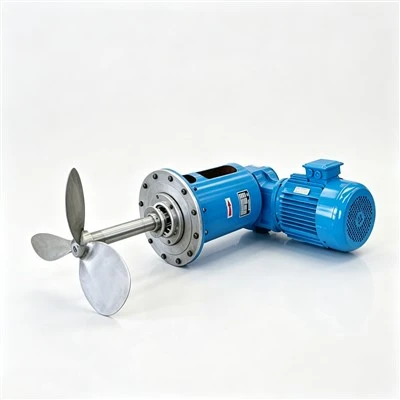
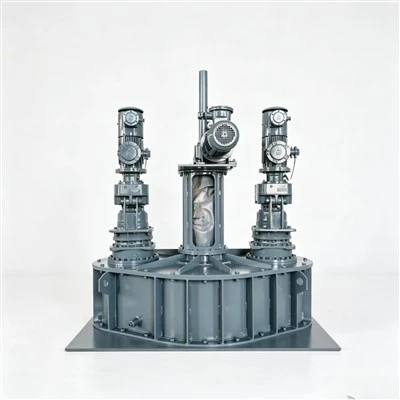
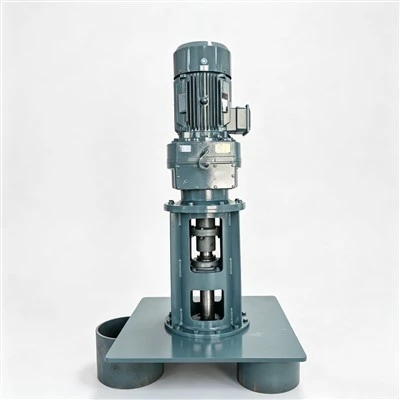
The working principle of a Vertical Agitator is primarily based on using a motor to drive the mixing shaft and blades through a transmission system. The rotating blades create continuous movement within the vessel, allowing different materials to mix, disperse, and become more uniform. During operation, the blades apply mechanical forces to the materials, causing them to circulate and exchange positions throughout the vessel, thereby improving overall material distribution.
First, the motor provides the driving force. A Vertical Agitator generally uses an electric motor as its main power source. After the motor starts, power is transmitted to the mixing shaft through a coupling, reduction gearbox, or other transmission components. The mixing shaft begins rotating under the driving force and moves the mixing blades installed on it, providing continuous power for material mixing.
Second, the mixing blades drive material movement. The mixing blades are essential components responsible for achieving effective mixing. As they rotate, they exert pushing, shearing, and disturbing forces on the surrounding materials, causing them to move in different directions. Depending on the blade design and installation arrangement, materials may form vertical circulation, radial flow, or other movement patterns. These movements increase contact between different material components.

Third, materials circulate inside the vessel. As the mixing shaft continues rotating, materials near the blades are pushed outward or moved through the vessel. Materials from other areas gradually enter the mixing zone and replace them. This continuous exchange creates an overall circulation pattern, allowing materials from different positions to interact repeatedly and reducing localized concentration differences.
Fourth, different components become more evenly distributed. When multiple materials are introduced into the mixing vessel, their initial distribution may be uneven due to differences in density, particle size, and flow characteristics. The Vertical Agitator continuously changes the positions and relative distribution of these materials through mechanical stirring, promoting contact between different components and improving mixing uniformity.
Fifth, the equipment supports material dispersion and homogenization. During the processing of liquids, slurries, and certain powders, materials may experience localized aggregation, sedimentation, or separation. The flow and disturbance generated by the mixing blades help disperse the materials and improve their overall mixing condition. In applications requiring solid particles to remain suspended, continuous stirring can also reduce particle settling and localized accumulation.
In addition, the actual operating performance of a Vertical Agitator is influenced by the shape of the mixing blades, the position of the mixing shaft, the vessel structure, and the properties of the materials being processed. For example, low-viscosity liquids and highly viscous slurries may require different mixing methods. Powders and granular materials also have different flow characteristics. Therefore, the equipment should be selected according to the actual materials and production processes.
It is important to note that simply rotating the mixing blades does not guarantee completely uniform mixing of every type of material. Material properties, loading conditions, mixing time, and equipment operating conditions all affect the final mixing results.
Overall, a Vertical Agitator works by using a motor to drive the mixing shaft and blades, creating material movement, circulation, dispersion, and interaction. These processes enable the equipment to achieve the mixing and homogenization required in industrial production.