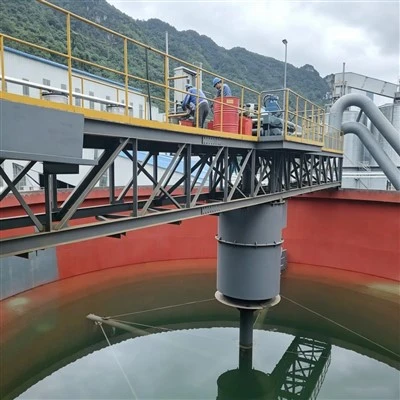
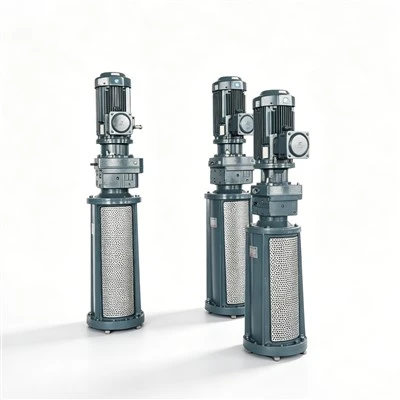
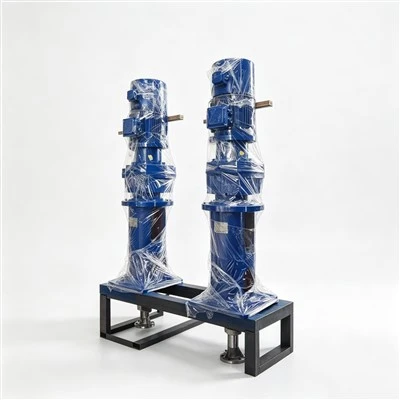
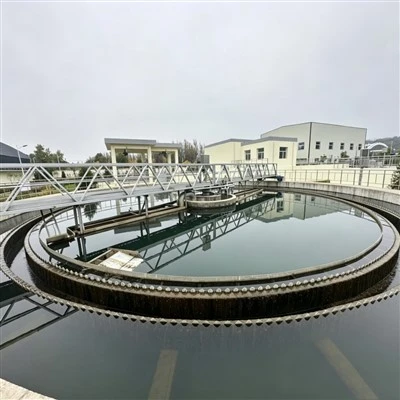
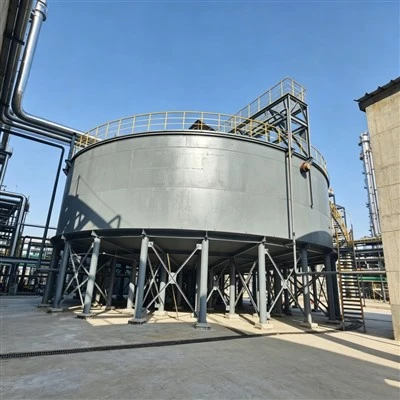
The Clarifier Thickener completes material clarification and concentration separation through a combination of natural gravity sedimentation and mechanical auxiliary collection, without the need for high-intensity external force intervention. Featuring stable operation and continuous working capacity, it adapts well to various industrial wet production processes. Its entire working cycle consists of four seamlessly connected core procedures: material diffusion, static sedimentation, mechanical sludge collection, and clear water overflow. In the initial material diffusion stage, solid-liquid mixed materials are smoothly fed into the tank through a central feeding cylinder. Unlike high-speed direct feeding, the built-in central water distribution structure buffers material flow velocity and eliminates the kinetic energy of inlet turbulence. This allows materials to spread uniformly across the entire tank cross-section at a low and stable flow rate. This procedure is critical for preventing high-speed water flow from disrupting the static water environment, creating stable conditions for solid particle sedimentation, and avoiding incomplete sedimentation caused by local water turbulence. In the subsequent static gravity sedimentation stage, materials inside the tank remain in a relatively static state. Thanks to the inherent density difference between solid particles and water, denser solid particles sink steadily under gravity, while fine suspended particles gradually agglomerate and settle in the stable static environment. A distinct layered structure forms inside the tank from top to bottom: a low-solid-content clear water layer at the top, a transition layer with slowly settling particles in the middle, and a thick slurry layer enriched with settled solids at the bottom. During the mechanical sludge collection stage, the bottom-mounted rake frame rotates at an extremely low speed without disturbing the sedimentation stability of the upper clear water layer and the middle transition layer. It only combs and collects compacted thick sludge deposited on the tank floor. The specially engineered rake frame structure steadily pushes dispersed bottom sludge toward the central underflow discharge zone, preventing sludge accumulation and hardening, maintaining bottom material fluidity, and eliminating residual sludge that may compromise operational efficiency. In the final clear water overflow stage, fully clarified upper water forms a stable liquid level and overflows uniformly through the peripheral overflow weir, flowing automatically into the clean water collection pipeline to finish the clarification process. The entire operation involves no complex mechanical movements and relies entirely on the coordination of physical gravitational principles and low-speed mechanical assistance to ensure stable and consistent performance. Compared with other separation equipment, its core advantage lies in full-range static sedimentation that preserves a stable material separation environment. Meanwhile, the mechanical sludge collection function compensates for the inability of pure natural sedimentation to achieve automatic sludge discharge, enabling fully automated and continuous operation including feeding, sedimentation, sludge collection, water outflow and sludge discharge. The equipment requires no frequent start-stop adjustment and supports 24-hour uninterrupted production with stable operation and seamless process transitions. Adopting pure physical separation without chemical additives or secondary pollution, the Clarifier Thickener serves as core supporting equipment for industrial solid-liquid pretreatment, material concentration and water purification, perfectly meeting the continuous operation requirements of various wet production processes.