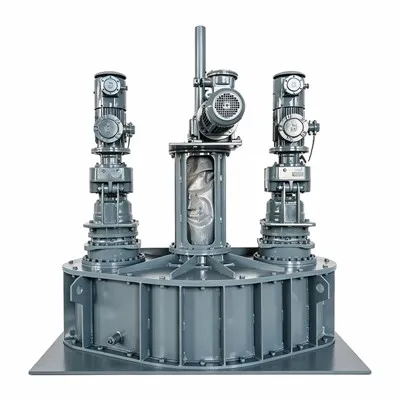
Shandong Ningye Machinery Equipment Co., Ltd. is one of the leading manufacturers and suppliers of solid-liquid separation thickener in China. With a professional production team, we are able to meet the needs of the majority of our customers. Please feel free to buy durable solid-liquid separation thickener at low price from our factory.
Introduction to Solid-Liquid Separation Thickener
Solid-Liquid Separation Thickener is a specialized equipment that achieves solid-liquid separation and concentration based on gravity sedimentation. Its core function is to concentrate low-solid-content suspensions (such as ore pulp, sewage, chemical waste liquid, etc.) into high-concentration underflow materials through physical sedimentation, while separating clear overflow liquid. It is widely used in solid-liquid separation, material concentration and resource recovery links in various industrial fields, with stable operation, convenient operation and adaptability to different working conditions.


Basic Structure of the Equipment
The Solid-Liquid Separation Thickener mainly consists of a tank body, transmission system, rake mechanism, feeding device, overflow device, underflow discharge device and auxiliary system, which work together to ensure stable separation and concentration.
Tank body:
Core bearing component, mostly cylindrical with a conical bottom (material: concrete, steel or welded plate), diameter 3-100m, depth 2-4m, 6°-12° bottom cone angle, with an annular overflow trough for clear liquid discharge.
01
Transmission system:
Central or peripheral transmission, composed of motor, reducer and worm gear, driving the rake frame to run slowly (1/3-1/5 r/min) to avoid disturbing settled particles.
02
Rake mechanism:
Composed of rake arms, teeth and tie rods; cross-arranged rake arms with 30° angle teeth push materials to the underflow outlet, and the rake frame can lift automatically to prevent overload.
03
Feeding device:
Includes feeding pipe, flow stabilizing cylinder and receiving plate, ensuring uniform pulp feeding, avoiding gas introduction and improving sedimentation efficiency.
04
Auxiliary system:
Optional flocculant adding, automatic control, degassing tank and hydraulic lifting devices to accelerate sedimentation and ensure stable operation.
05
Equipment Classification and Application Scenarios
(I) Equipment Classification
• Central transmission type: Small diameter, usually within 24 meters, compact structure, suitable for small and medium-sized processing scales. It is mainly composed of an annular tank, a rake and a central transmission mechanism, with convenient operation and maintenance.
• Peripheral transmission type:
It is divided into peripheral roller transmission and peripheral rack transmission. The peripheral roller transmission is a large and medium-sized equipment, with a diameter usually around 53 meters, up to 100 meters, large processing capacity, suitable for large mines, metallurgical plants and other scenarios; the peripheral rack transmission type has a diameter of more than 53 meters, which is rarely used at present.
According to the function, it can be divided into ordinary thickener, high-efficiency thickener and deep cone thickener: ordinary thickener relies on natural sedimentation, with underflow concentration of 30%~50%, suitable for coarse particle materials; high-efficiency thickener is equipped with flocculant system and automatic control, with high sedimentation efficiency and underflow concentration of 50%~70%, suitable for fine particle materials; deep cone thickener is of conical design, with aspect ratio of 1:1 and above, and underflow concentration can exceed 70%, suitable for extremely fine particles or high viscosity materials.
Application Scenarios
The equipment is widely used in production sites that need solid-liquid enrichment and separation, such as hydrometallurgy, mineral processing plants, chemical plants, sewage treatment plants, etc., including:
Mining field: Treating mineral processing pulp to realize concentrate concentration and tailings dewatering, and improve resource recovery rate, such as gold ore, copper ore, molybdenum ore and other mineral processing processes.
Metallurgical field: Leaching and washing in hydrometallurgy, tailings treatment, such as uranium tailings concentration and iron and steel plant wastewater treatment.
Chemical field: Treating chemical waste liquid and reaction products to realize material recovery and wastewater purification, and reduce environmental emission pressure.
Environmental protection field: Municipal sludge treatment and industrial sewage treatment, reducing the solid content in sewage, improving the effluent quality, and facilitating subsequent treatment.
Other fields: Solid-liquid separation in food and pharmaceutical industries, tail coal slime water treatment in coal washing plants, etc.
Core Parameters and Performance Characteristics
(I) Core Parameters
Processing capacity:
According to different equipment specifications, the processing capacity ranges widely, from several cubic meters per hour for small equipment to thousands of cubic meters per hour for large equipment.
Concentration effect:
The solid content of feed is 10%~20%, the solid content of underflow is 45%~55%, and the high-efficiency and deep cone models can be increased to more than 50%~70%. The solid content of overflow can be controlled below 1g/L .
Rake frame rotation speed:
1/3~1/5 r/min, which can be adjusted according to material characteristics. For coarse particle materials, it can be appropriately increased, and for fine particle materials, it is controlled within 3~4m/min linear speed.
Equipment specifications:
Diameter 3~100m, depth 2~4m, total height of deep cone model 8~16m, diameter 5~10m.
(II) Performance Characteristics
- Simple structure and convenient operation, no complex manual intervention, continuous operation can be realized, and labor cost can be reduced.
- Low power consumption and stable technical indicators. Compared with other solid-liquid separation equipment, it has lower operation cost and is suitable for long-term continuous production.
- Optimized design to avoid common problems: degassing tank is added to prevent bubbles from affecting sedimentation, serrated overflow weir to avoid local suction, and curved rake teeth to improve underflow concentration and reduce blockage risk.
- Strong adaptability. According to material characteristics and processing capacity requirements, the equipment specifications, materials and auxiliary systems (such as flocculant addition and automatic control) can be customized.
- It can work with other equipment, such as filter press, to reduce the processing load of filter press and improve the overall solid-liquid separation efficiency.
Comprehensive service

Answers to Common Customer Questions
1. What are the core advantages of the equipment? What is the difference from other solid-liquid separation equipment (such as filter press)?
The core advantages are low energy consumption, simple operation and continuous operation, which can handle large flow and low concentration suspension. The difference from filter press: the thickener focuses on "concentration" and cannot directly produce dry materials; the filter press focuses on "dewatering". The two are often used together to reduce the load of the filter press.
2. Which materials is the equipment suitable for? Can both coarse and fine particle materials be processed?
It is suitable for all kinds of suspensions containing solid particles, and both coarse and fine particles can be processed: ordinary models are suitable for coarse particles, fine particles need to choose high-efficiency models with flocculant, and deep cone models are recommended for extremely fine/high viscosity materials; it is not suitable for high-concentration concentration of coarse particles to avoid blockage.
3. What daily maintenance is required during the operation of the equipment? Is the maintenance cost high?
Daily maintenance mainly includes checking the lubrication of transmission components, the state of the rake frame and instrument calibration. The process is simple, no professional personnel are needed, wearing parts are easy to replace, and the maintenance cost is low.
Hot Tags: solid-liquid separation thickener, China solid-liquid separation thickener manufacturers, suppliers, factory